Publications:
Who Marries Whom? The Role of Segregation by Race and Class
American Economic Review (2026, lead article)
Non-Technical Summary | County Level Marriage Patterns
WSJ | Marginal Revolution | WSJ (video) | Marginal Revolution 2 | Harvard Gazette
Abstract
Americans rarely marry outside of their race or class group. We distinguish between two possible explanations: a lack of exposure to other groups versus a preference to marry within group. We develop an instrument for neighborhood exposure to opposite-sex members of other race and class groups using variation in sex ratios among nearby birth cohorts in childhood neighborhoods. We then test whether increased exposure results in more interracial (white-Black) and interclass (top-to-bottom parent income quartile) marriages. Increased exposure to opposite-sex members of other class groups generates a substantial increase in interclass marriage, but increased exposure to other race groups has no detectable effect on interracial marriage. We use these results to estimate a spatial model of the marriage market and quantify the impact of reducing residential segregation in general equilibrium. For small changes in exposure, the model implies effects in line with recent estimates from policy experiments. We then use the model to assess the overall contribution of segregation and find that residential segregation has large effects on interclass, but not interracial, marriage.
Working Papers:
Job Market Paper
When Resources Meet Relationships: The Returns to Personalized Supports for Low-Income Students
Non-Technical Summary | Slides
The Atlantic | Cornell Chronicle | Harvard GSAS News | Congressional Briefing | Dream On - Short Documentary (EdRedesign X Fire-Works)
Abstract
Children from low-income families face barriers outside the classroom that impede learning and limit opportunities for economic mobility. We study Communities In Schools (CIS), a program that places coordinators in high-poverty schools to connect struggling students with personalized support. Coordinators match students to resources that address academic, behavioral, and basic needs---such as tutoring, mental health counseling, and housing stabilization. CIS is the largest program of its kind in the U.S., reaching 2 million students annually. Using the staggered rollout of CIS, we find that the program boosts test scores for struggling students. These gains persist, raising high school completion and adult earnings. Improvements in test scores explain only about half of CIS's impact on high school graduation; the remainder reflects progress on non-cognitive outcomes such as attendance and behavior. Consistent with CIS's emphasis on personalization, coordinators tailor services to distinct student needs, yet students with different needs experience comparable long-run gains. Placing a trusted adult in schools, backed by a network of programs and services, may offer a scalable way to improve economic mobility.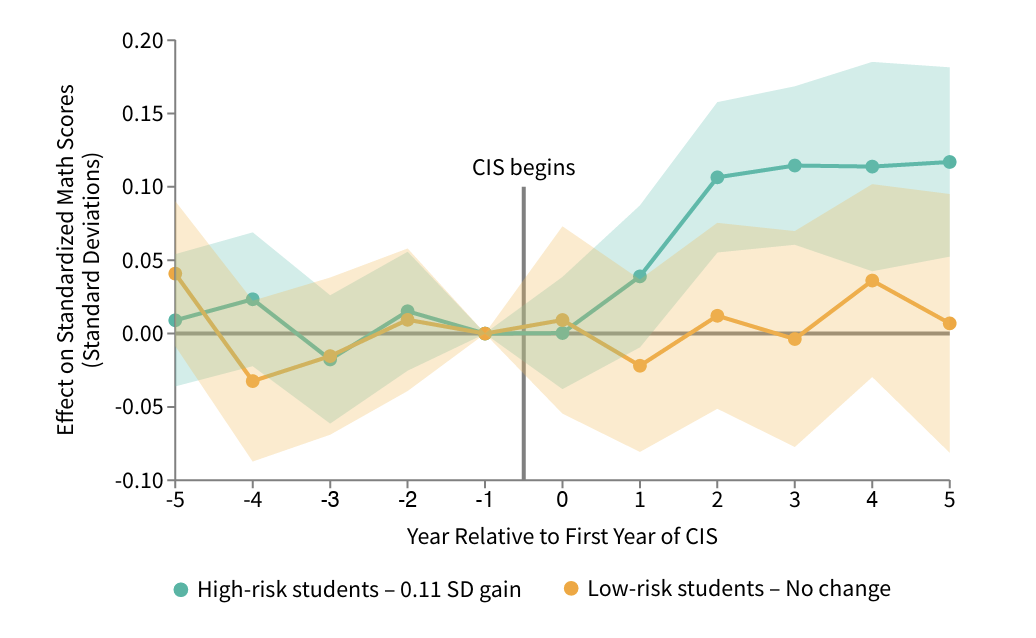
Missing Together: The Long-Run Costs of Student Absenteeism
Abstract
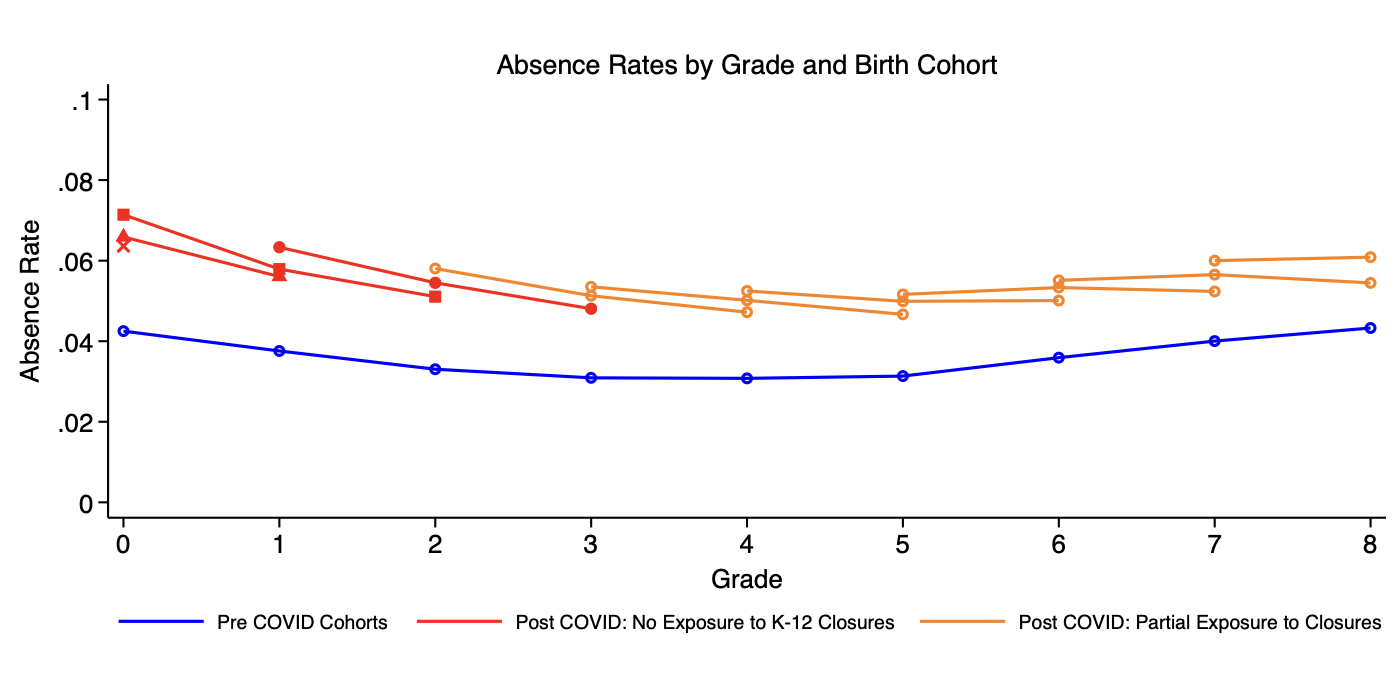
Since schools reopened after COVID-19, students have missed substantially more school each year than before the pandemic. In Texas, the increase occurred throughout the distribution of prior attendance and appears even among cohorts that entered school after pandemic-era closures. Peer absences predict student outcomes conditional on a student's own attendance. To estimate the causal effect of changes in school-cohort-level absences prior to the pandemic, I build a leave-out attendance instrument from local attendance shocks across neighboring schools. I establish the validity of the instrument by showing that only shocks that occur before outcomes are measured have an impact on those outcomes. Aggregating the shocks across grades 1 through 9 yields large effects of school-cohort attendance on long-run outcomes. Moving from the 75th to the 25th percentile of the school-by-cohort absence distribution would increase high school graduation by 2.6 percentage points and average earnings at age 25 by $4,000. Classroom heterogeneity suggests that peer externalities amplify group-level effects beyond the direct effect of a student's own absences.